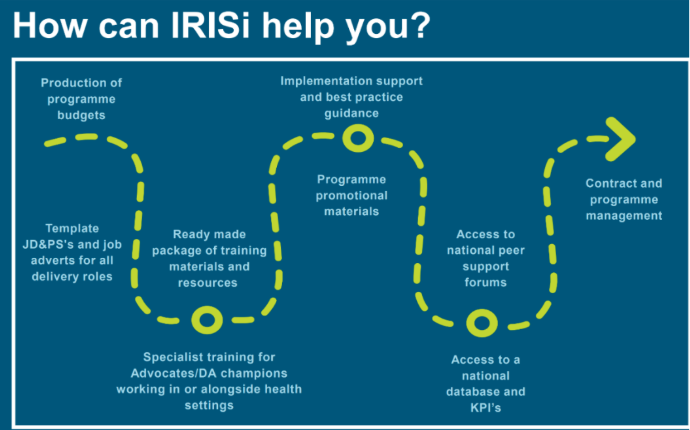
Last week, we were delighted to welcome colleagues from Integrated Care Boards (ICBs) to our information event exploring how the IRIS (Identification & Referral to Improve Safety) programme can support local delivery of Steps to Safety, a national initiative led by the Department of Health and Social Care (DHSC) and NHS England.
The event brought together ICB representatives who have submitted an Expression of Interest for the first phase of the programme, providing an opportunity to share learning and explore how IRIS could support local delivery, if they are successfully awarded funding by DHSC.
As ICBs begin planning how they would deliver the service locally, many are exploring proven approaches that align with the programme’s requirements while building on existing good practice.
At IRISi, we shared how the IRIS programme can support these ambitions. For almost 20 years, we have worked alongside primary care teams, commissioners and specialist domestic abuse services to strengthen the healthcare response to domestic abuse and sexual violence, particularly in general practice. The programme is underpinned by evidence, research and learning, and provides an established framework that can be commissioned locally and adapted to meet the needs of individual systems.
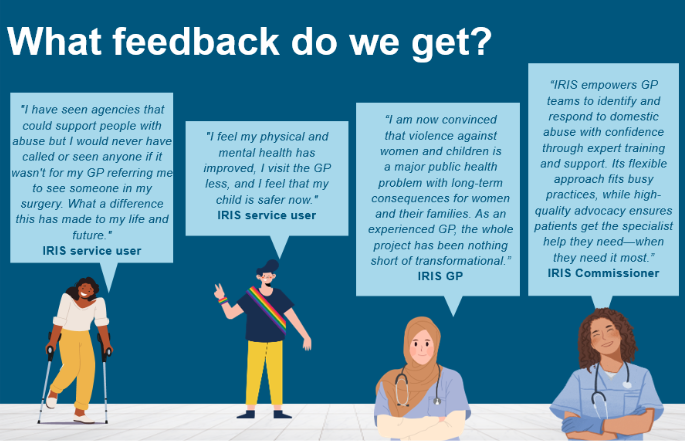
At its heart, IRIS is about ensuring that more survivors are safely identified, listened to and connected with specialist support. We know healthcare professionals are often in a unique position to recognise the signs of domestic abuse and sexual violence and offer a safe opportunity for someone to seek help. Every conversation started and every survivor identified has the potential to be a vital first step towards safety.
The IRIS model strengthens the relationship between primary care and specialist domestic abuse services through dedicated Advocate Educators, evidence-based training and clear referral pathways. We work in partnership with local systems to understand their communities, existing services and priorities, supporting implementation in a way that reflects local need.
In 2023/24:
* An estimated 15,800 survivors were identified and supported through the IRIS programme across England and Wales.
* More than 4,600 healthcare professionals received specialist training through 1,091 training sessions delivered by over 100 Advocate Educators.
* Nearly two-thirds of service users had not previously accessed specialist domestic abuse or sexual violence support, demonstrating the role IRIS plays in reaching people who may otherwise never receive specialist help.
Independent research has also shown that practices delivering the IRIS programme are 30 times more likely to refer patients into specialist domestic abuse services than practices without the programme.
Reflecting on the event, Medina Johnson, CEO of IRISi, said:
“It was wonderful to see so many ICBs at yesterday’s event, all sharing a commitment to strengthening the response to domestic abuse within primary care.
As ICBs consider how they will deliver Steps to Safety locally, they do not have to start from scratch. IRIS is an established, independently evaluated programme that can be commissioned locally, providing a proven framework that aligns with the ambitions of Steps to Safety while allowing flexibility to meet local needs.
We look forward to continuing conversations with ICBs exploring how IRIS could support delivery in their area.”
Thank you to everyone who joined us and contributed to such valuable discussions.
If you’re exploring how the IRIS programme could support delivery in your area, we’d love to hear from you. Whether you’re developing your current plans or thinking ahead to future Expressions of Interest, our team would be pleased to talk through how IRIS works and what implementation looks like.
Contact our team: Network@irisi.org